
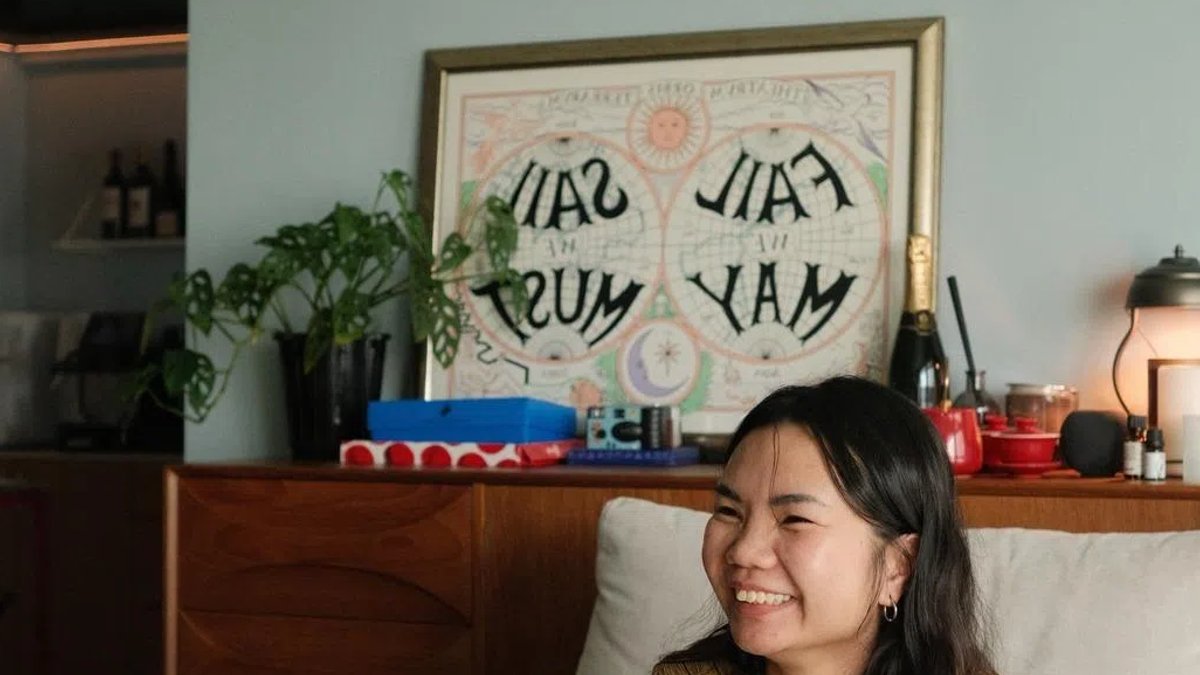
Jade Cham spent her school years avoiding conversations about where she lived. Her home was a HDB studio apartment, a space primarily built for elderly residents, and she felt it marked her as somehow lesser among her peers. Years later, that cramped apartment would become the foundation of her career.
From Embarrassment to Design Philosophy
When Cham was young, her family of six downsized from a spacious private property due to financial difficulties. The shift stripped away the helper, the toys, and the small “library” she had created with her siblings. “To me, it felt like we had lost everything,” she recalled.
The only private space she could claim was the back of a bedroom door, decorated with stickers while she imagined how comfortably her friends slept in actual bedrooms. As she got older, she turned to Tumblr, collecting images of beautiful rooms and dreaming of living in them.
But those years of longing were already pointing her toward interior design. “As a child, I resented my parents for putting us through all that. Now, I’m proud to share how staying in a small home has shaped me,” she said.
Related: Agents Face Exams If They Close Only 3 Deals
Building a Career Without Training
After graduating with a degree in accountancy in 2014, Cham took a risk. She joined an interior design firm with no formal training or experience in the field. Today, she runs Knock Knock Studio and has become one of the few Singaporean designers featured on Never Too Small, a YouTube channel that showcases small-space design projects worldwide.
One of her featured projects is a 2-room HDB flat in Sengkang. The 10-minute video highlights custom furniture Cham designed from scratch, including a mobile kitchen island with a built-in laundry hamper and a storage bench that slides neatly under the television console. What the video does not show is where these ideas really came from.
Cham’s father worked as a metal fabricator. When the family first moved into their downsized home, he improvised “ugly but useful” solutions to make the small space livable. He used Toyogo boxes to create a cozy corner for her sister and her Hello Kitty dolls, and hung a curtain to separate her brother’s sleeping area from the living room. “Thinking back, it was pretty cool that we had little sections for ourselves,” Cham said.
That hands-on problem-solving shaped how she approaches design today. Cham frequently uses wardrobes as room dividers. When that is not possible, she relies on changes in lighting and materials to signal transitions between different areas. “Having a dad who likes to build random stuff to make life easier taught me that anything is possible if we think creatively,” she said.
Related: New Hyatt Centric debuts in Sapporo
Lessons From Living Close Together
Sharing a bomb shelter-turned wardrobe with her siblings taught Cham another lesson: many tensions in small homes stem from unclear ownership of space. To reduce friction, she now plans storage deliberately, assigning specific units to specific people and purposes. In the Sengkang flat, she built the wardrobe with an open cabinet at one end so frequently worn clothes can be accessed without handling the narrow passage between the wardrobe and the bed.
Small spaces demand honesty in design. “It is harder to hide bad design in small spaces,” Cham said. “Every decision becomes amplified.” Small homes feel intimate and honest, she noted, and there is something pure about that.
Living in tight quarters also requires homeowners to practice restraint. They must let go of the idea that more is always better and start curating their belongings, even when it means parting with items that hold sentimental value. Cham herself has not kept a single report book from her schooling days.
“If you approach this process with resentment, it will feel restrictive. But if you approach it with intention, it can be very freeing,” she said. “Personally, I have realized I do not need a lot of things to feel good.”
Related: Commercial plumbing contractors and the management of sewer line cleaning in Denver
The close quarters also shaped family trends in unexpected ways. “There was nowhere to withdraw when you feel overwhelmed, but there was also an unexpected sense of closeness. We became highly aware of one another’s habits and learned to understand and respect each other’s needs,” Cham reflected.
A Full-Circle Renovation
A few years ago, Cham returned to the same apartment that had once made her feel ashamed. Her mother had been diagnosed with cancer and was struggling with mobility. The home needed to be redesigned to accommodate her changing needs.
Cham measured the space, discussed options with her siblings, and went to IKEA together to shop for furniture. Piece by piece, the siblings assembled everything themselves, easing their mother into this new chapter of life. The transformation was modest compared to Cham’s other projects, but it reminded her why she had chosen this path.
“Interiors are not just about aesthetics, but about improving a person’s quality of life,” she said. “In the end, a home is not defined by its size, but by how it supports the people inside it.”


