
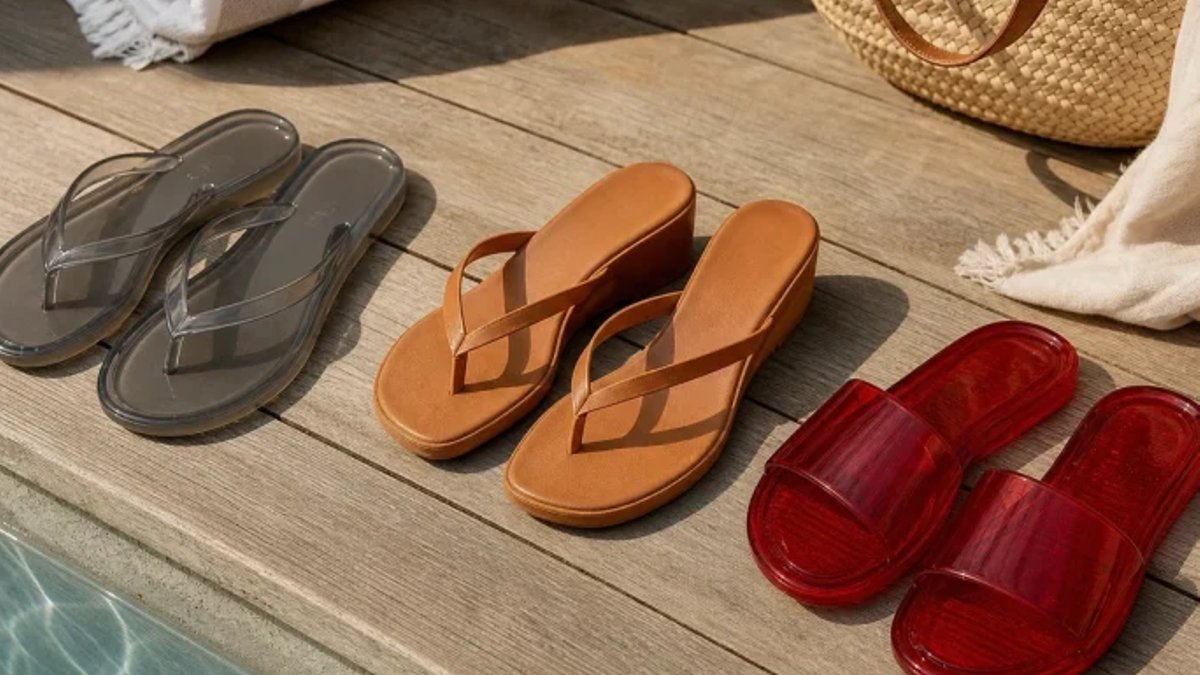
Summer 2026’s most prominent shoe trends revolve around two retro styles: jelly slides and wedge flip-flops. Both have returned with contemporary refinements, though their practicality differs significantly based on walking distance and terrain. Jelly slides, once notorious for causing blisters and discomfort, now lead the market with improved designs. The most critical upgrade involves the footbed, where modern versions feature cork or cushioned insoles instead of the rigid plastic that previously caused friction.
High-end brands like The Row, Skims, and Melissa have popularized these styles beyond flat designs, extending into slides, kitten heels, and transparent TPU mules. The slide version, in particular, excels for daily wear—a one-piece molded PVC or TPU upper combined with an adjustable strap eliminates the need to grip the shoe, reducing slippage and blister formation.
Red dominates jelly slides this season
Color trends for jelly slides show a strong preference for red tones this season, with cherry and true reds dominating, followed by color-blocked and two-tone variations. Pricing ranges from affordable options starting at $25 to designer versions reaching $65. Despite these improvements, even the best jelly slides lack adequate arch support for all-day wear, and bare PVC can become uncomfortably hot on pavement.
Wedge flip-flops have also returned but with a more refined profile. Unlike the bulky Y2K platforms of the past, 2026’s versions are slim and architecturally precise, featuring micro-wedges and angled soles that provide slight heel elevation. Brands such as Khaite and Reformation have positioned these as polished options for evenings rather than spring break, though their toe-post design can exacerbate hammertoes and bunions during prolonged wear.
A podiatrist’s assessment highlights fundamental limitations of flip-flops. The American Podiatric Medical Association explicitly warns against extended walking in flip-flops, citing risks including plantar fasciitis and sprained ankles. The footbed’s construction determines a shoe’s practicality. Cork or cushioned insoles outperform flat soles, particularly on hot surfaces. Podiatrists recommend twisting the sole in-store to test its flexibility—a sole that folds flat provides no protective structure.
Individuals with flat feet or bunions should avoid toe-post wedges and unsupported thongs unless paired with foot powder and blister patches to reduce friction. Styling considerations also play a role: cherry-red jelly slides complement white cotton sundresses or cropped jeans, while wedge flip-flops pair best with tailored trousers or linen shirts to maintain a polished appearance. The guiding principle is to match the shoe to the occasion rather than forcing an outfit around it.
Waterproofing and breathability upgrades transform comfort
Material advancements in 2026’s jelly slides and wedge flip-flops address two persistent summer shoe challenges: waterproofing and heat management. The one-piece molded PVC or TPU upper found in slides repels water and sand effectively, drying quickly without warping, a marked improvement over older jelly shoes that absorbed moisture and stretched. Even budget options now incorporate sealed TPU linings to prevent water seepage, though this reduces breathability in humid conditions.
Styling these sandals requires intentional pairing to balance fashion and function. Cherry-red jelly slides, the season’s dominant color, work best with breathable fabrics, white cotton sundresses, cropped linen trousers, or bare legs with ankle socks for a sporty contrast. The focus should remain on the shoe without overwhelming the ensemble. Wedge flip-flops demand a more elongated silhouette, pairing well with high-waisted tailored trousers or midi slip dresses, where the wedge’s slight lift creates a streamlined look.
Pairing them with wide-leg jeans or chunky sneakers undermines their architectural design. For jelly slides, strap tension is critical, a strap that is too loose will slide off mid-stride, while one too tight can dig into the arch. The ideal position sits snugly at the widest part of the foot, just below the ankle, a detail that prevented many of the strap-induced blisters seen in 2024’s initial jelly shoe adopters.


