
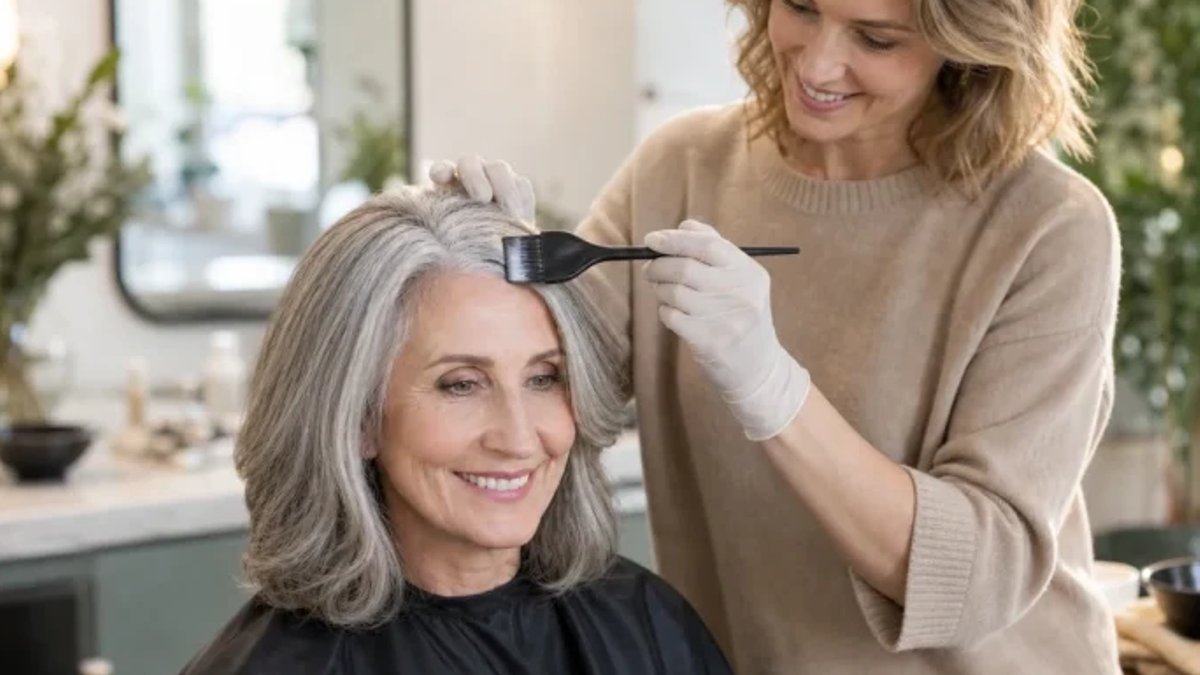
For those over 60, a clear salon gloss is emerging as a popular solution to revive dull gray hair, offering a straightforward method to enhance shine without the commitment of permanent dye. Priced from around $30, this treatment maintains its luster for four to six weeks, providing a balanced option between frequent coloring and no treatment at all. However, not all glosses yield the same results, and an unsuitable choice can leave gray hair with an unwanted lilac tint rather than a radiant finish.
Understanding the Science of Shine
A gloss is a demi-permanent treatment with a mildly acidic pH ranging from 3.5 to 4.5. This acidity smooths the hair cuticle, which is particularly beneficial for gray hair. Gray and white hairs tend to be drier and more porous than pigmented hair, causing light to scatter instead of reflect. After applying a gloss, the cuticle becomes smooth, allowing light to bounce back evenly, instantly enhancing the clarity of the silver tone.
The effectiveness of a gloss in combating dull gray hair stems from surface physics rather than product magic. It’s important to note that a gloss does not conceal gray hair. The pigments only penetrate the outer layers of the hair and gradually wash out with each shampoo. At best, gray strands receive a subtle tint, blending into the overall hair tone. For complete coverage, permanent color or highlights are necessary.
Current trends lean toward gray blending, which incorporates natural gray hair into the style, often using a combination of highlights and gloss for seamless transitions. When done professionally, the results last up to 25 washes, significantly longer than at-home treatments. After a salon appointment, it’s key to wait 24 to 48 hours before shampooing to ensure longevity.
Clear vs. Toned Gloss: Making the Right Choice
A clear gloss contains no color pigment and solely focuses on sealing the hair cuticle. While this may seem limited, it’s ideal for very light gray hair, offering maximum shine without any color risk. However, it lacks the ability to neutralize yellowing, which is where toned glosses in silver or charcoal come into play.
The principle behind toned glosses is rooted in color theory. Violet, being opposite yellow on the color wheel, cancels out warm tones. The challenge lies in the hair’s porosity. White-gray hair absorbs pigment unevenly and more quickly, leading to a lilac hue if left on too long. This effect is more noticeable on silver hair, though it washes out after a few shampoos. On darker hair, the issue is less apparent.
A recent independent lab test of purple shampoos revealed that out of 20 products, only seven received top ratings, with several failing to neutralize yellow tones. Testers explicitly warned against exceeding the recommended application time. For precise results, a salon consultation is advisable over selecting a product from retailers like Target, Walmart, or CVS.
Read Also: Crafters Create Unique Yarn Gnomes with Simple Supplies
For nearly white or very light gray hair, a clear gloss is recommended. Toned silver shades should only be used after a strand test at the salon, where processing time (5 to 30 minutes, depending on hair condition) is tailored to individual needs. Whether a cool shade complements your complexion depends on your overall coloring. If you prefer cool tones, ashy blondes are a suitable option for cooler seasons.
Schedule a gloss appointment in the morning, not before an evening event. The treatment looks best after the hair has cooled and settled, following gentle styling.
Timing, Cost, and At-Home Alternatives
For consistent shine, aim for a gloss treatment every six to eight weeks, ideally coinciding with your haircut. This ensures the effect remains without waiting for dullness to return. For finer hair, the interval may need to be slightly shorter to maintain optimal reflection.
Salon prices start at around $30 but vary based on hair length and location. Coastal cities typically charge more than the Midwest or South. At-home glosses begin at approximately $15 but lack the precision of professional application.
Drugstore shine masks, applied in 3 to 10 minutes, deposit pigments on the hair surface and provide temporary softness. However, the pigments sit loosely on the cuticle, lasting only 3 to 5 washes. On porous gray hair, results can be uneven.
Prolonging the Shine
To extend the life of a gloss, switch to sulfate-free shampoo and reduce washing frequency. These steps help preserve the flattened cuticle. Using a cool setting for blow-drying also aids in maintaining smoothness without disrupting the treated surface.


