
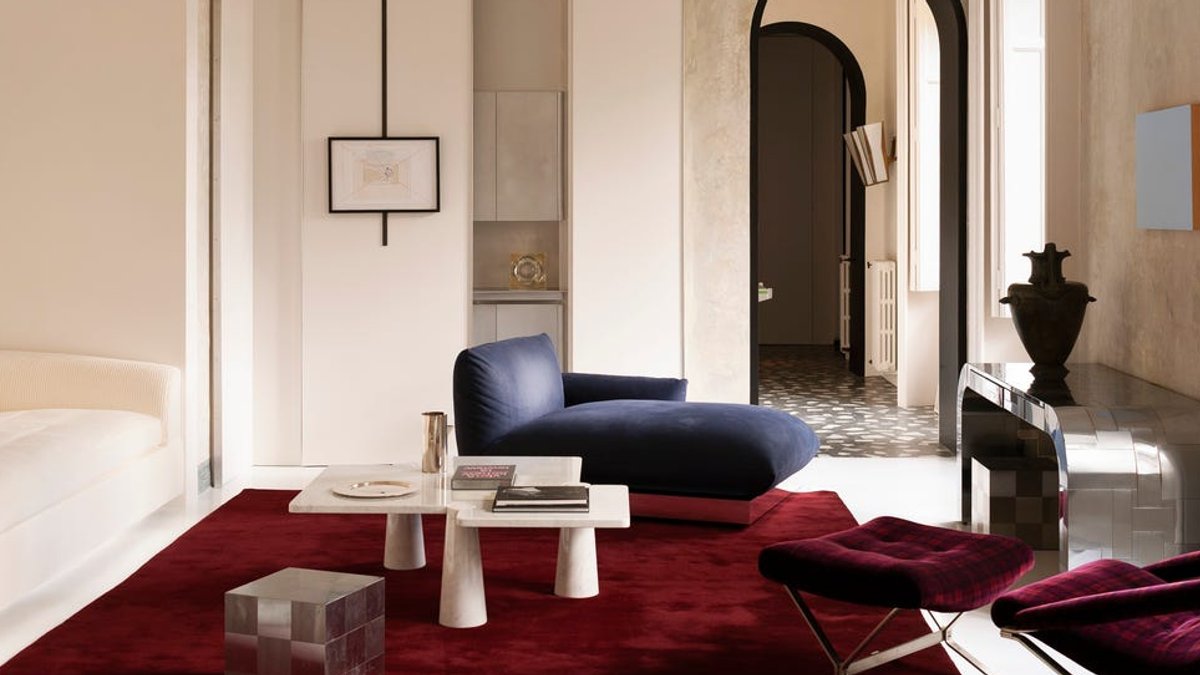
A 16th-century palace in Naples has become a model for blending history with contemporary design. The Palazzo Cellamare, one of the city’s most important buildings, has long served as a gathering place for architects and artists, including Ferdinando Sanfelice, famous for its grand staircases, and Caravaggio, who resided there during his final year. Now, architect Giuliano Andrea dell’Uva has restored an apartment within the palace, maintaining its historical character while introducing modern touches.
Restoring What Was Lost
The apartment dell’Uva renovated was part of a section damaged in World War II, leaving no visible traces of its original decorative features. However, restorer Maria Paola Castellano discovered hidden seminato patterns and Carrara marble floors beneath layers of paint. Dell’Uva chose to emphasize these findings with a contemporary design approach. The restoration required only minor structural adjustments—enough to restore sightlines of the century-old garden visible from the living area.
This project demonstrates a growing trend in historic preservation: achieving harmony between conservation and creative reinterpretation. Unlike many restorations that either replicate the past or impose a single modern style, dell’Uva’s work intentionally layers different eras. The result is a space where 18th-century Del Vecchio ceramics coexist alongside 1970s steel furniture, creating a visual conversation between time periods rather than a conflict.
Architectural and Artistic Legacy of the Palazzo Cellamare
The palace reflects contributions from multiple architects beyond Ferdinando Sanfelice, including Ferdinando Fuga and Giovanni Battista Manni, whose work shaped its design through the mid-20th century. Beneath the building, underground spaces were repurposed in that era, forming the basis for the historic Metropolitan Cinema, a project led by architect Stefania Filo Speziale.
Interior decoration features works by several local artists, including Giacomo del Pò, Pietro Bardellino, Giacinto Diano, and the Fischetti family. The palace also hosted Caravaggio in its final year, marking a notable artistic connection to the building’s history.
Merging Past and Present
The apartment’s color palette draws inspiration from artworks by Sol LeWitt, David Tremlett, and Robert Barry, with those tones reflected in velvet upholstery, rugs, and the dining room walls behind sliding steel doors. A Murano glass shelf in the entryway displays dell’Uva’s favorite lamp, the Sasso by Luigi Caccia Dominioni, a reference to his Milan studio’s influence. The owner, who shares dell’Uva’s appreciation for both antiques and modern art, entrusted him with full creative freedom to blend the two styles.


