
The architecture firm Mosley Thorold solved a design challenge in a west London conservation area by focusing on two brick columns at the rear of a Georgian townhouse. That observation became the guiding principle for a project that had previously stalled. Founded in 2017 by Nathaniel Mosley and Henry Thorold, the firm took on the task of renovating two properties: a listed Georgian townhouse and a 1970s mews house located across its courtyard.
The solution involved mirroring the existing brick columns on the mews house, establishing a visual connection while maintaining the historic character of the older structure. Original structural elements in the townhouse were preserved, and the integrity of the late-Georgian interior was kept intact.
Modern materials were incorporated thoughtfully. Corten steel and brass were used throughout both buildings, uniting them while providing a striking contrast to the Georgian mouldings and handmade tiles. The industrial texture of the steel was intentional, creating a deliberate contrast with the historic elements. Nathaniel Mosley explained, ‘It was about creating the space for the materially rich moments to sing.’
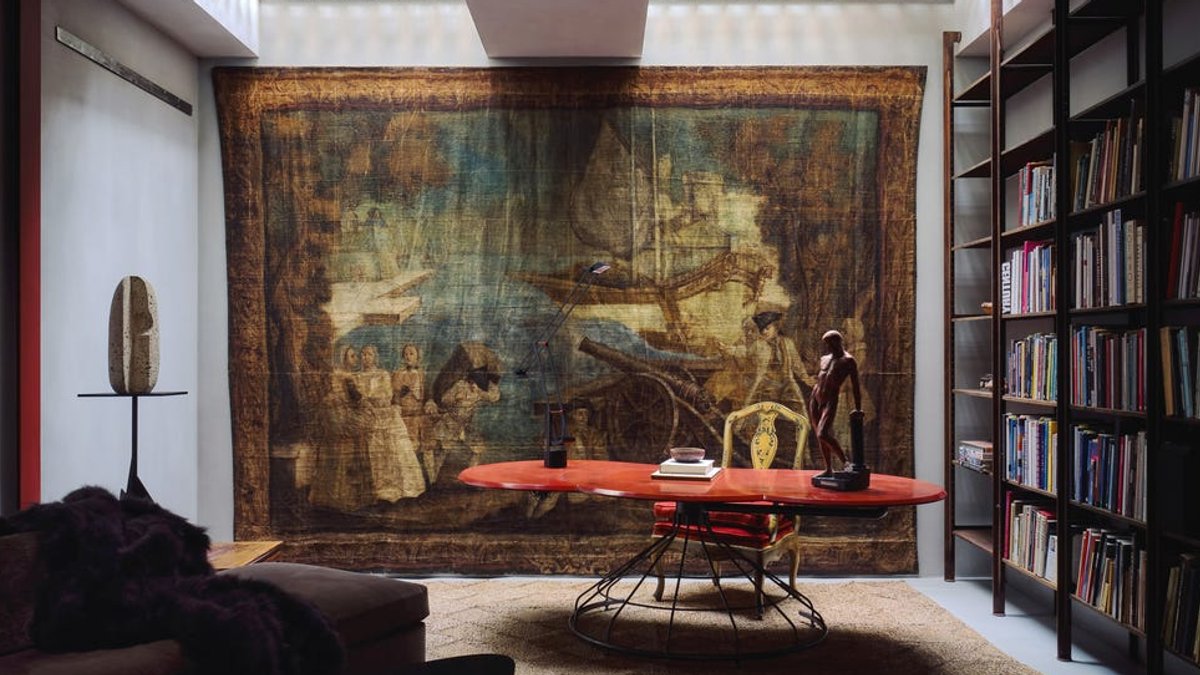
The 1970s mews house allowed for greater flexibility in design. Mosley Thorold excavated to create a basement, installed floor-to-ceiling windows, and added three-metre-high doors to maximize natural light. The resulting space was versatile, functioning as a gallery, office, cinema room, and more.
The client, gallerist Rebecca Willer, owned a significant collection of antique furniture and art. These pieces bridged the gap between the historic townhouse and the modern mews house, reinforcing the idea that the two buildings would function almost as a gallery when complete, as Henry Thorold noted, ‘We knew that the two houses would function almost as a gallery when they were complete.’
The project’s strength lies in its careful balance—two distinct architectural periods brought together through proportion, shared materials, and meticulous craftsmanship. The brick columns that initially inspired the design became the central element in harmonizing the old with the new, resulting in a seamless integration of history and modernity.


